Parish History pages in association with


Categories

Welcome to the Parish History pages

North Stoneham has a long and illustrious history, and the site of St Nicolas is believed to have been a place of worship for the past 1,000 years. We would like to hear from anyone with stories, information, and questions connected with the parish's past. history@nsab.org.uk
 

An even earlier photograph of St Nicolas?

Posted by Webmaster on April 25, 2012
img317-edit-low.jpg
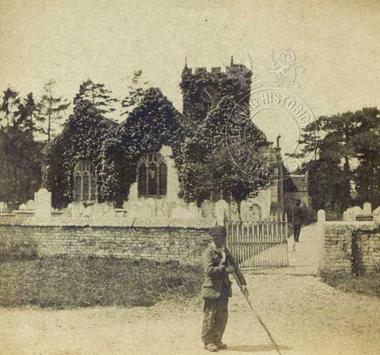
Soon after posting the previous photograph of St Nicolas, which dated from around 1870, another photograph appeared - perhaps from the 1860s? It is one half of a stereoview, which explains the positioning of the figures in the image - designed to give 3-D depth when looked at through a stereoscopic viewer. The boy in the foreground was using the stick to help him keep still for the long photographic exposure. The ivy on the church is much more unruly than in the last photograph, with the castellations of the tower engulfed in growth.

Early photograph of St Nicolas, 1869-72

Posted by Webmaster on March 26, 2012
img984-edit-low.jpg
Amongst the Willis Fleming Historical Trust's collection of Victorian photographs of North Stoneham and Chilworth - taken over a short period between 1869-72 - is this photograph of St Nicolas. It is the earliest photograph of the church's exterior that we know of. The Rector at this time was Rev. Frederick Beadon, who had been the incumbent since 1811.

The first parish magazine in January 1887

Posted by The Willis Fleming Historical Trust on December 17, 2011
125 years ago the first parish magazine for North Stoneham was published in the New Year of 1887. The Rector, Rev. E. Kenworthy Browne, wrote: 'This Magazine, it is hoped, will be a medium of communication for our widely scattered parish, and will be found to contain a monthly record and notice of events of common interest, but nothing short of vigorous support can make it in any sense pay.'

mag1887-1.jpg
mag1887-2.jpg
mag1887-3.jpg
mag1887-4.jpg

The Transfiguration window at St Nicolas

Posted by Webmaster on December 8, 2011
historical-image.jpg
The new painted glass at St Nicolas added from 1826 to 1828 included a version of Raphael's The Transfiguration (1826) executed by John A. Edwards of Winchester. It was destroyed during the Second World War. (Source: Harry Willis Fleming).

Lord Hawke, Quiberon Bay, and North Stoneham

Posted by Webmaster on November 18, 2011
St Nicolas Church is the final resting place of Admiral Lord Hawke (1705-1781), the Victor at the Battle of Quiberon Bay in 1759.

hawkes.jpg
Born in 1705, Edward Hawke entered the Royal Navy aged 15. His early career involved much travel, especially to the West Indies and America, but little action. However, when action came, at the Battle of Toulon (1744), when he commanded HMS BERWICK, he proved decisive and aggressive.

In 1747 he was promoted to Rear Admiral and the following year commanded a squadron in the successful Second Battle of Cape Finisterre. By the outbreak of the Seven Years war in 1756 he was a full Admiral and was sent to relieve Admiral Byng in the Mediterranean after the latter's notorious failure at Menorca leading ultimately to his execution by firing squad.

Hawke never enjoyed the full confidence of the first Lord: Admiral Anson at the beginning of the war, but he was eventually entrusted by Anson with the task of preventing the invasion of Britain by the French in 1759 when he was given command of the Western Squadron. Hawke maintained a successful close blockade of Brest for six months, preventing Admiral Conflan's fleet from sailing in support of the invasion.

In severe weather in November 1759, Hawke's squadron had to abandon its blockade and, unguarded, Conflan escaped from Brest with 21 French ships of the line and made to join up with the invasion transports in Quiberon Bay. Back at sea again, Hawke gave chase and came in contact with the French at the entrance to Quiberon Bay. In fading light and a rising wind, Hawke's ships pursued the French with ferocity and out-fought them in every respect gaining a dramatic and significant victory and ending French Maritime aspirations during the war.

Hawke's connection with North Stoneham arises from his lease of Swaythling House to the south of where the airport is at present. His wife Catharine lived there for considerable periods whilst Hawke was at sea. She raised their 4 surviving children there. Sadly after 20 years of married life she died when he was in the Mediterranean in 1756 and was buried in their local church: St Nicolas. She was buried in the nave of the church.

In later life, Admiral Hawke went on to become First Lord of the Admiralty and was ennobled as Baron Hawke of Towton, in 1776.

On his death, in 1781, whilst he may have expected greater national recognition by perhaps being buried in St Pauls, and although he had not lived in Swaythling for some time, he chose to be buried with his wife. His son, the Second Baron, erected a magnificent memorial to him in 1783, the work of John Francis Moore. It includes a relief of the famous painting of The Battle of Quiberon Bay by Serres.